field report
The Last Hour of the Clock: What the Parking Search Costs You
Between six and nine in the evening the ramps fill and the lots spill onto the shoulders. A night spent watching the search for a legal space, and the arithmetic of shutting down forty five minutes early every day.
 Mile Marker
Six in the Evening: The Lot Is Already Two Thirds Full
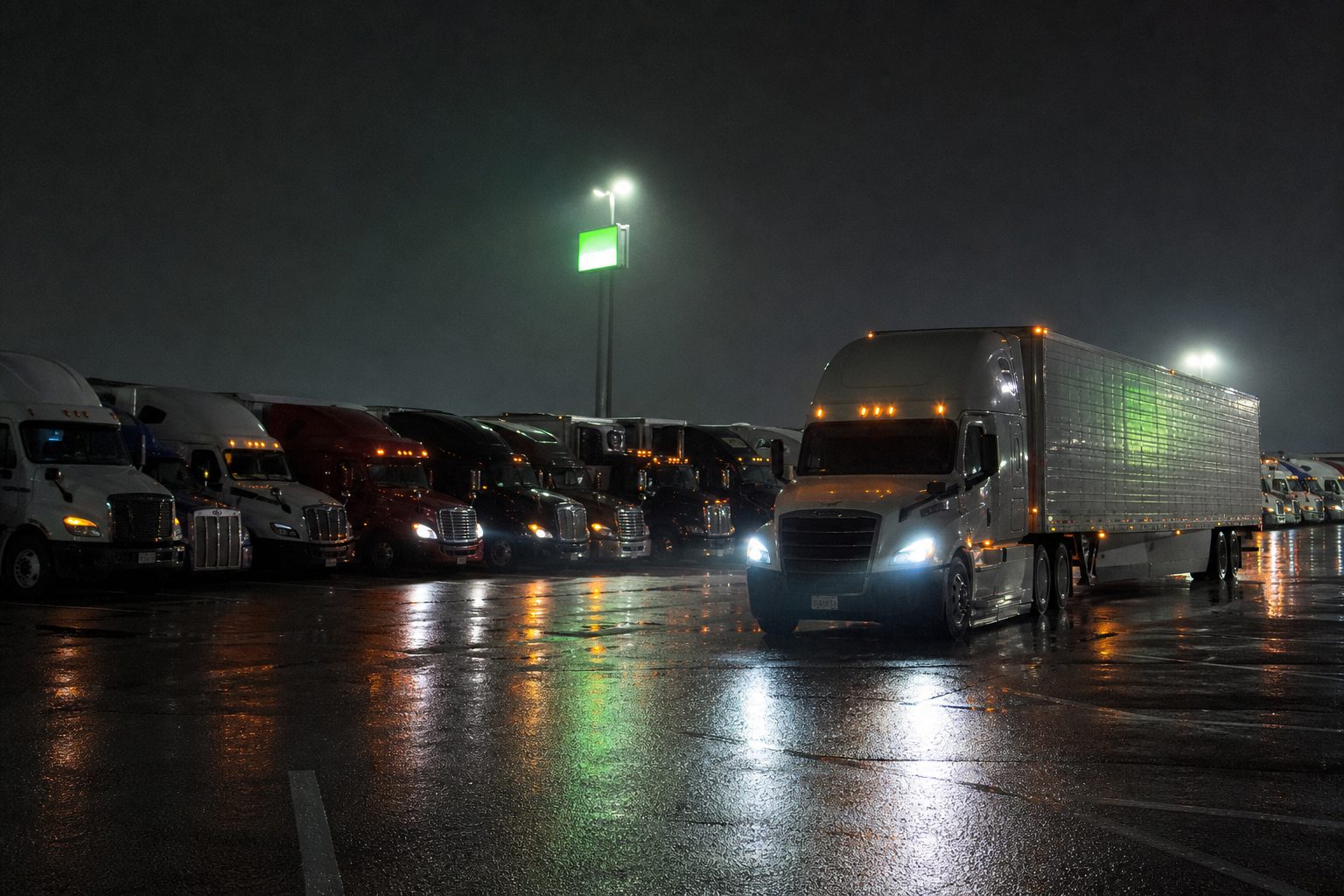
At six o'clock in the evening, a rest area on I-70 in eastern Missouri looks like a game of Tetris played by tired hands. Bobtail tractors slide in behind reefers. Flatbeds squeeze along fence lines where grass is yellow from exhaust and tires. Overhead, the sun is still an hour from the horizon, but the lot is already two thirds full. The back rows have only a handful of open slots. By seven, those will be gone.
Drivers walking their dogs or waiting in line for the restroom swap the same stories. The later you roll in, the less likely you'll find a legal spot within your clock. By eight, newcomers cruise up and down the aisles, scanning for tail lights and signs of movement. Some idling trucks look abandoned, but nobody wants to risk a blocked-in spot.
In truck stops with electronic signs, the count ticks down: 8 spaces, then 3, then 0. The app on your phone might say there are still openings, but by the time you arrive, the numbers are wishful thinking. The "no parking" signs at the entrance are ignored as drivers wedge their rigs along curbs, knowing that highway patrol might sweep through at any hour.
Keep reading: How to Build a Fuel Surcharge Table From the EIA Diesel Index
How the 11 and 14 Hour Clocks Force the Search Window
Hours of Service (HOS) rules dictate the shape of a driver's day. The 11 hour driving limit and the 14 hour on-duty window set the outer edges of every work plan. When your day starts at six in the morning, the math is clear: you must park and be off the road by eight in the evening, at the latest. The law leaves no room for error. Shutting down even a few minutes late can mean a violation in a roadside inspection or during a company audit.
The practical effect is a narrowing of the parking search window. Most drivers plan their shutdown to begin at least 30 to 45 minutes before their 14 hour clock expires. That buffer covers unexpected slowdowns: traffic, weather, a delay at the shipper, or a missed turn. Once the clock hits zero, you can't legally drive to another location to park, no matter how full the first lot is.
Even if you have driving hours left, you may face a hard cutoff if you're stuck in congestion or if earlier stops didn't line up. The closer you run to the end of your clock, the more stressful the search for parking becomes. Some drivers start looking as much as 90 minutes before their legal limit, especially in metro areas or along busy freight corridors.
Ramps, Shoulders, and the Ticket Risk of an Illegal Space
Once the lots fill up, drivers face a harsh choice: keep searching and risk an HOS violation, or park somewhere not meant for trucks. Interstate ramps fill up fast, with trucks lined nose to tail along the merge lane. Shoulders of on-ramps and off-ramps become impromptu parking lots, sometimes with more than a dozen rigs before midnight.
Parking on a ramp is technically illegal in most states. State police patrols and DOT officers write tickets for illegal parking, especially at rest areas and on ramps near urban centers. Fines range from a few dozen dollars to several hundred, depending on the state and the officer's mood. Some locations tow rigs at the owner's expense. Drivers also worry about safety: a ramp is loud and exposed, with a higher risk of rear-end collisions from inattentive motorists.
Tradeoffs and Risks
For owner operators, an illegal parking ticket is more than a nuisance. It can mean points on your CSA score, increased insurance premiums, and time lost dealing with paperwork. Some drivers accept the risk because there simply are no legal spaces left within range of their clock. Others will risk a violation for a few hours' sleep, knowing they can't safely keep driving. The decision is made one day at a time, often with no good options.
Keep reading: Leased On or Your Own Authority: The Cost Math for One Truck
Reserved Parking: What It Costs and When It Pays for Itself
Reserved parking is now a fixture at most major truck stop chains. For a fixed fee, drivers can guarantee a spot, often through an app or kiosk. The price varies by region and demand, but it is common to pay between 15 and 30 dollars for a single night. At some urban stops, the cost can go higher, especially during peak shipping seasons.
For some, the peace of mind is worth it. A guaranteed spot means no wandering from lot to lot, no risk of a ticket, and a better shot at a full rest period. The cost, however, adds up over the course of a year. If you buy a reserved space three nights a week, that's more than 2,300 dollars in twelve months. For a two truck carrier, that's a noticeable dent in net profit.
When Reserved Parking Makes Sense
Reserved parking is most cost effective on high volume lanes where parking is always scarce: near major cities, coastal ports, or key interstate junctions. Some drivers use it as a fallback after a bad experience: a ticket, a near miss with a tow, or a ruined night's sleep after circling for an hour. For others, it's a line item in route planning, built into the cost per load. The decision usually comes down to the tradeoff between lost time and cash outlay.
The Split Sleeper Option and Who It Actually Helps
The split sleeper berth rule allows drivers to split their 10 hour rest period into two segments: one period of at least 7 hours in the sleeper and another of at least 2 hours, with neither counting against the 14 hour window. Used well, it offers flexibility when parking is tight or a delivery appointment lands in the middle of the night.
In practice, the split sleeper is most useful for drivers who run irregular schedules, or who routinely load or unload at facilities with odd hours. It also helps those caught by surprise: you can take a shorter break when parking is available, then finish your rest later at a less crowded time. However, it requires careful logging and a good grasp of the rules to avoid an inadvertent violation.
Who Benefits Most
Owner operators with consistent lanes may find the split sleeper more trouble than it's worth. Planning a predictable shutdown every night simplifies the day and reduces stress. For drivers who haul local or short regional routes, or who stay east of the Mississippi, it can help them avoid the worst parking crunches. Long haul carriers running coast to coast still face the same math: eventually, every driver needs a full 10 hour break, and parking is just as tight.
See how DeadheadMath handles this for trucking and logistics
Shippers, Receivers, and the Overnight Parking Question
Some shippers and receivers allow trucks to park overnight on their property. This is more common in the Midwest and South, less common near major cities. Facilities that do allow it often have only a few spaces, and they fill up fast. Security concerns, liability insurance, and township ordinances all play a role in whether overnight parking is allowed.
For drivers, the ability to sleep on site is a major advantage. It eliminates the last mile scramble and lets you maximize your driving hours for the next day. Some shippers even allow parking before early morning appointments, reducing the risk of a late delivery. However, it is the exception, not the rule. Many facilities post signs warning drivers not to park overnight and enforce it with tow trucks or security patrols.
Negotiating With Facilities
Some carriers make it a point to ask about overnight parking when booking freight. Dedicated lanes and long-term contracts are more likely to include parking privileges. For spot market loads, it is often a gamble. A few minutes of advance communication with shipping or receiving staff can save hours of searching later, but not every facility has the flexibility or space to offer parking.
The Arithmetic of Forty Five Lost Minutes a Day Across a Year
Every time a driver shuts down 45 minutes early to secure parking, that is 45 minutes of drive time lost. Multiply that by 250 working days in a year, and you have more than 187 hours that could have been spent moving freight. At an average highway speed of 60 miles per hour, that's over 11,000 miles of lost driving annually for each truck.
The lost time hits revenue directly. For an owner operator paid by the mile, those 11,000 miles represent a significant chunk of annual income. Even for those paid by the load, an earlier shutdown can mean missed opportunities for reloads or delayed deliveries that ripple through a week's schedule. For a two truck carrier, the impact doubles. Over a year, these lost hours can mean the difference between a break-even operation and a profitable one.
The cost is not just fuel or labor. Early shutdowns mean more time spent idling, higher out-of-pocket costs for meals and showers, and increased wear from circling or parking in less-than-ideal spots. The arithmetic is plain: time spent looking for parking is time not spent earning. Every extra mile driven off route to find a spot is deadhead that comes straight off the bottom line.
What Drivers Do Instead: Earlier Shutdowns and Planned Lanes
Faced with the realities of the parking shortage, most drivers adapt. Some make a habit of shutting down in the late afternoon, even if it means sacrificing potential earnings. Others plan their routes around known parking hot spots, aiming for smaller, less crowded lots or timing their stops earlier in the day. A few get creative, networking with other drivers or local businesses to secure a safe place for the night.
Technology helps with planning, but the information is only as good as the last update. Some drivers use apps to check parking availability, but report that spaces fill up faster than the data can be refreshed. Word of mouth and personal experience still matter more than any electronic map. The best route planners build in flexibility, with backup locations in mind for every shutdown.
For small fleets and owner operators, tracking the cost of lost time, extra miles, and paid parking is essential. A load profitability calculator that includes fixed cost modeling and per lane history gives a real picture of what the parking search actually costs. Tools that track these numbers across weeks and months let drivers and owners put hard numbers to soft frustrations and make better decisions the next time the lots start to fill up.